Aybel Spaces — Brand Development
A family-run garden room company in Oxfordshire, rebranded to match the quality of what they actually build.
Logo, colour system, typography, photography direction, tone of voice
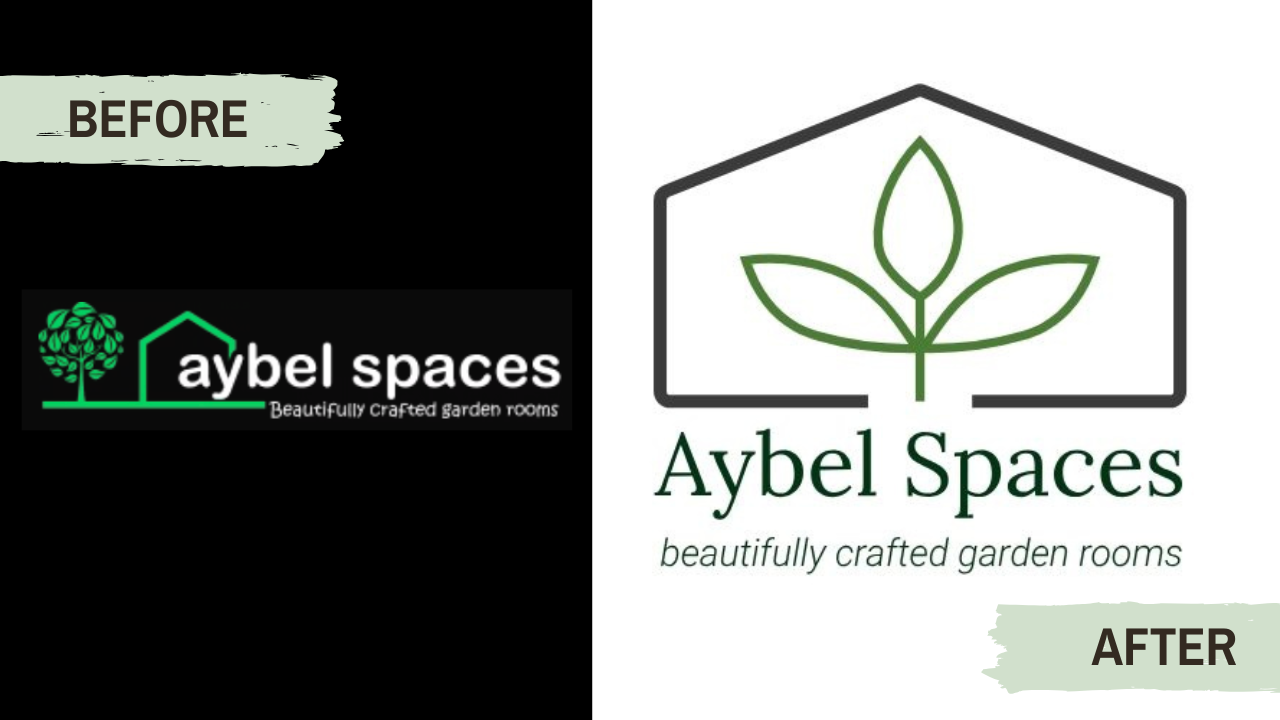
Aybel Spaces design and build garden rooms across Oxfordshire. The business had been running for several years, had built a solid reputation locally, and had no shortage of work. What it had outgrown was its visual identity. The existing brand, a dark background, lime green, a clip-art tree sitting next to a flat house outline, communicated trade contractor rather than design-led craftspeople. For a company whose whole proposition is the quality and care of what they build, that gap between the product and the packaging was costing them.
The brief was a full rebrand: new logo, new colour system, new typography, photography direction, and a tone of voice that could carry the brand across every touchpoint without sounding like a building company trying to sound like a lifestyle brand.
01 / Logo
From clip-art to craft
The original logo had two problems. The first was technical — dark background, high-contrast lime green, a visual weight that read as aggressive on screen and illegible at small sizes. The second was strategic. A clip-art tree next to a generic house outline doesn't communicate craftsmanship. It communicates a category.
The new logo keeps the architectural house form because it earns its place — Aybel builds structures, and the shape is both honest and instantly legible. What changes is everything else. The outline is stripped back to clean, confident line-work. Inside it sits a botanical illustration: a central leaf form flanked by two lateral leaves, drawn with enough detail to feel considered and enough simplicity to scale properly at any size. The wordmark uses Lora, a classic serif, set in a deep forest green that anchors the whole system.
The result reads as a brand that takes its work seriously without announcing it. There is no lime green, no black background, no visual noise competing for attention. On the sand neutral ground the brand now sits on, the logo feels placed rather than pasted.
02 / Colour
A palette that earns the word "natural"
Garden room brands tend to reach for green and call it a day. The connection to nature is obvious enough that the instinct makes sense, but without considered execution it produces palettes that look like they were assembled in five minutes and forgotten about.
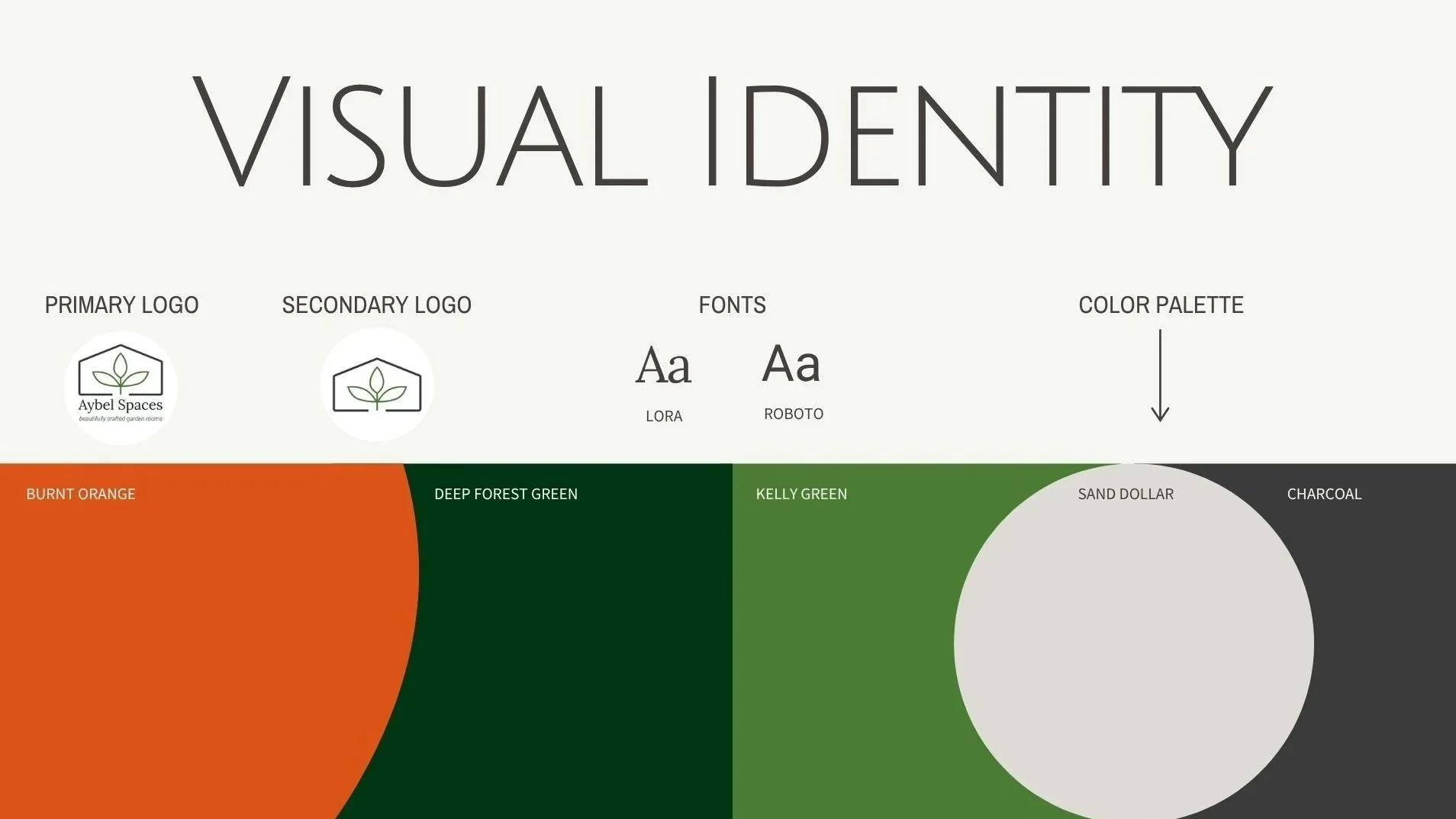
Aybel's colour system is built around five values that work properly together rather than simply coexisting.
Deep forest green anchors the palette. Rich, dark, grounded — it reads as nature without being cartoonish about it.
Kelly green is the mid-tone that handles the logo illustration and accent moments. Lively without being sharp.
Charcoal replaces the old solid black as the text and structural colour. Warmer, easier to read, more considered.
Sand dollar is the neutral ground — a warm off-white that gives every other element room to breathe and immediately separates the brand from the cold white backgrounds that saturate the category.
Burnt orange is the accent. It doesn't appear often, but when it does it adds enough warmth and distinctiveness to make the palette feel complete rather than restrained.
Together the system communicates warmth, craft, and calm. It reads as a brand built by people who care about materials and detail, which is exactly the claim Aybel makes about its garden rooms.
03 / Typography
The right pairing for where the brand sits
Typography in a rebrand this size rarely gets discussed explicitly, but it carries more weight than people expect. The wrong typeface at headline level undermines everything else in the system.
Lora handles headings and display use. It's a transitional serif with calligraphic roots — elegant without being precious, and it carries the warmth the brand needs without tipping into the overtly decorative. At larger sizes it conveys craft; at smaller sizes it remains readable without effort.
Roboto handles body copy, captions, and interface elements. Clean, geometric, and approachable — it sits back when it needs to and doesn't compete with the headline work. The combination positions Aybel in the space between a premium design brand and a family business, which is precisely where they belong.
04 / Tone of Voice
Warm and honest, not corporate and not trade
A brand voice for a company like Aybel has one central challenge: it needs to communicate quality and design-consciousness without sounding like it's trying too hard to impress people who live in converted farmhouses. The trap is tipping into the language of interior design brands that use words like "curated" and "artisanal" until they mean nothing. The other trap is staying so rooted in trade language that the copy reads like a quote from a builder's merchant.
The voice framework sits between those two positions. It speaks as a family business — direct, warm, unpretentious — but it is specific about craft and considered about design. It uses plain language to describe things that are genuinely well made. It doesn't overclaim. It doesn't hide behind lifestyle copy when what it means to say is: we build these carefully, and they last.
The tone is confident enough to describe quality without the qualifier "luxury," and honest enough to talk about what a garden room actually does for a household without dressing it up in aspiration it doesn't need.
05 / Photography Direction
Lifestyle-led, material-honest
Photography guidance for Aybel was framed around a single principle: show the space in use, not just the structure. A garden room photographed empty against a flat grey sky communicates a product. A garden room with warm morning light coming through full-height glazing, a coffee on the desk, and a garden visible beyond the frame — that communicates a life improved.
The direction calls for natural light throughout, warm tones over cooled or over-saturated grades, and a generous use of negative space in composition. Detail shots of materials and joinery sit alongside wider lifestyle images to give the brand range across different formats and contexts. Human presence should be subtle rather than staged — a hand, a book, a coffee cup — enough to imply the life being lived in the space without making the photography feel like a catalogue shoot.
The outcome
The rebrand was approved in full. The new identity gave Aybel Spaces a visual foundation that reflects the quality of what they actually build and the confidence it created led directly to a full website redesign and build by us within the same engagement.
Simon & Angie Ward
“I want to thank you again for creating such an amazing website, it really is amazing and we love it. Secondly to thank you for being patient with us,”